How to Choose Dimmable Lighting for Your Business?

Time:2026-10-02 Author:Aria
0%

Choosing the right lighting can change how customers feel, work, and move through your business. A warm, adjustable glow may make a café feel comfortable. A brighter setting may help staff inspect products or complete detailed tasks. This is why many owners search for practical guidance on how to Choose Dimmable Lighting for Business.

Lighting researcher Dr. Peter Boyce offers a useful principle: “Lighting should serve people, not merely illuminate spaces.” His view reflects an important business reality. Dimming is not only about saving energy. It can support customer comfort, employee focus, product presentation, and changing daylight conditions. A retail store may need stronger light during cleaning hours. Later, softer levels can create a calmer shopping atmosphere.

Start with the business activity. Consider room size, ceiling height, window exposure, and the visual tasks performed there. Check whether fixtures, dimmer controls, and lamps are compatible. Poor compatibility can cause flickering, buzzing, or an uneven glow. That looks unprofessional.

Test before buying in bulk. Place sample fixtures above a counter, display shelf, or reception desk. Observe the light at morning, midday, and evening. Small differences matter.

Color temperature deserves attention too. Warm white can feel welcoming, while neutral white often supports clearer work. Yet there is no universal answer. A restaurant, clinic, warehouse, and showroom need different lighting strategies.

A perfect solution may not exist. Budgets, wiring, controls, and staff preferences can conflict. Still, careful testing reduces expensive mistakes. The best choice balances visual comfort, operating costs, maintenance needs, and the real experience of people using the space.
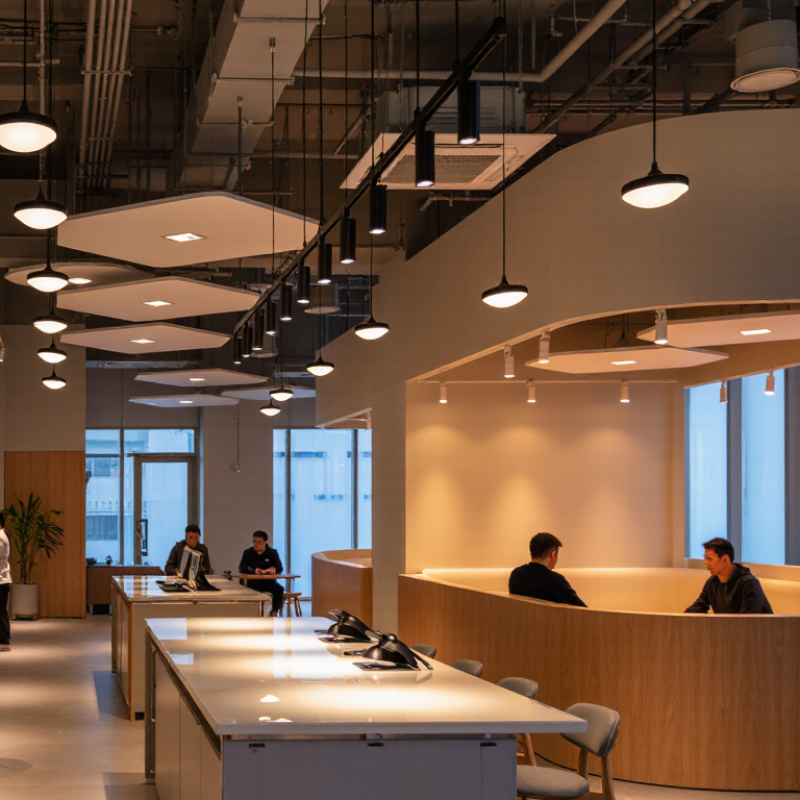
How to Choose Dimmable Lighting for Your Business?

Define Your Business’s Lighting Needs and Dimming Goals

Choosing dimmable lighting starts with your business’s actual lighting needs, not a fixture’s appearance. Walk through each space at different times of day. Note dark shelves, reflective counters, glare on computer screens, and areas where customers hesitate. A café may need softer evening light, while a workshop needs stable brightness for detailed tasks. Write down these differences before selecting equipment.

Define your dimming goals in practical terms. Do you want lower energy use, stronger visual comfort, flexible ambience, or all three? Set separate targets for entrances, workstations, displays, and meeting areas. Test the light at full output and at its lowest setting. Some LED systems flicker, hum, or shut off when dimmed too far. Check the driver, control method, minimum load, and electrical requirements together. A qualified electrician should verify installation details and local safety compliance.

Small trials reveal problems early. Place sample fixtures over a real counter, desk, or product display. Observe shadows on faces and color changes on white surfaces. I have seen attractive layouts fail because the lowest dimming level was unusable. That mistake is worth examining. Staff feedback can also expose discomfort that measurements miss. Keep records of brightness levels, operating hours, and control preferences. These details support a reliable decision and make future adjustments less expensive.

How to Choose Dimmable Lighting for Your Business?

Define Your Business’s Lighting Needs and Dimming Goals

Different business areas require different maintained illuminance levels. Use the chart as an initial planning guide: brighter task areas generally need more light, while circulation and hospitality areas can use lower levels and deeper dimming. Final targets should be checked against local regulations, space design, and visual-comfort requirements.

The illuminance values represent common planning ranges in lux. The dimming target indicates the approximate minimum output level many businesses may use during lower-activity periods while maintaining suitable visibility.

Compare Dimming Technologies and Control Compatibility

How to Choose Dimmable Lighting for Your Business?

Dimmable lighting should match both your space and control system. In a café, staff may need bright light during cleaning and softer light during dinner service. A compatible dimmer can make that change smooth. An incompatible one may cause flicker, buzzing, limited dimming, or sudden shutdowns.

Phase-cut dimming suits many small installations, but leading-edge and trailing-edge systems do not behave identically. Check the fixture’s driver requirements before selecting a wall dimmer. For larger commercial spaces, 0–10V control offers stable, gradual adjustment through low-voltage wiring. Digital systems can provide zoning, scheduling, occupancy responses, and feedback. They may require more planning and trained installation. Wireless controls can reduce rewiring, yet signal reliability depends on walls, distance, and interference.

Test the complete setup, not only the lamp. Connect the actual driver, dimmer, sensor, and control panel. Observe performance at the lowest setting, after warm-up, and during repeated switching. Ask the installer to confirm load limits, wiring methods, emergency-lighting requirements, and future maintenance access. I once trusted a compatibility chart too quickly. The lights dimmed in the showroom but flickered in the finished room. That mistake taught me to test under real conditions. A perfect specification sheet cannot reveal every installation problem. Leave some flexibility in the design, because operating habits may change.

Choose Suitable Fixtures, Lamps, and Color Temperatures

Choosing dimmable lighting for a business begins with the fixture, not the dimmer switch. Select housings that match the room’s ceiling height, viewing angles, and maintenance routine. Recessed fixtures suit clean, even illumination, while track heads add flexibility for displays. Narrow beams highlight products. Wider beams reduce harsh contrast across tables and walkways. Check glare from customer eye level.

The lamp or LED module must work with the dimming system. Confirm the minimum dimming level, driver compatibility, and flicker performance before installation. A lamp that dims smoothly in a showroom may flicker after ten units share one circuit. Test a small group at full brightness, half brightness, and the lowest setting. Pay attention to buzzing, delayed starts, and uneven light. These details are easy to miss.

Color temperature shapes how people experience the space. Warm 2700K to 3000K light can make restaurants, lounges, and boutiques feel comfortable. Neutral 3500K to 4000K light usually supports offices, salons, and general retail. Cooler light may help detailed tasks, but it can make skin tones and fabrics appear less inviting. Use high color rendering for merchandise, artwork, and food. Do not assume one temperature fits every area. A warmer fitting near a reception desk and a neutral fitting in a work zone may perform better. My own preference can be too warm, so sample colors beside real materials before committing.

How to Choose Dimmable Lighting for Your Business? - Choose Suitable Fixtures, Lamps, and Color Temperatures

Use this comparison table to match commercial lighting fixtures with suitable applications, lamp technologies, dimming controls, and color temperatures. Values are typical planning ranges and should be verified against the selected product's technical documentation.

Fixture Type Typical Business Applications Recommended Lamp or Light Source Common Dimming Method Suitable Color Temperature Recommended CRI Typical Dimming Range Typical Efficiency Selection Considerations
Recessed LED Downlight Offices, reception areas, corridors, small retail spaces, and hospitality interiors Integrated LED module or replaceable LED lamp Phase-cut 0–10 V DALI 3000–4000 K 80+; 90+ for merchandise, artwork, or premium interiors 10–100%, depending on driver and control system 80–120 lm/W Check ceiling depth, glare control, beam angle, driver compatibility, and minimum dimming level.
LED Panel Light Open-plan offices, classrooms, clinics, meeting rooms, and general commercial areas Integrated LED panel with a separate dimmable driver 0–10 V DALI Digital control 3500–4000 K 80+; 90+ where accurate color appearance is important 1–100% on compatible systems; some drivers have a higher minimum level 90–130 lm/W Choose low-glare versions for computer-based work and confirm compatibility with occupancy or daylight sensors.
LED Track Spotlight Retail stores, galleries, showrooms, restaurants, and feature displays Integrated LED spotlight or dimmable LED reflector lamp Phase-cut 0–10 V DALI 2700–3500 K for warm retail settings; 3500–4000 K for bright merchandising 90+ for products, food, artwork, and high color accuracy 10–100%, subject to driver and control compatibility 70–110 lm/W Match beam angle to the target: narrow beams create accents, while wider beams provide broader coverage.
LED Linear Pendant Workstations, conference tables, reception desks, dining areas, and collaborative spaces Integrated LED linear module with dimmable driver 0–10 V DALI Wireless control 3000–4000 K 80+; 90+ for hospitality and design-focused environments 1–100% with a suitable driver and control system 85–120 lm/W Consider direct/indirect light distribution, suspension height, glare rating, and visual comfort for seated users.
LED Troffer Large offices, healthcare facilities, institutional buildings, and grid-ceiling installations Integrated LED troffer with a dimmable electronic driver 0–10 V DALI Networked control 3500–4000 K 80+; higher CRI may be specified for clinical or inspection areas 10–100%, depending on the driver 95–135 lm/W Verify ceiling-grid dimensions, glare performance, emergency-lighting requirements, and sensor integration.
Dimmable LED Bulb or Retrofit Lamp Decorative pendants, small offices, cafés, restaurants, and existing socket-based fixtures Dimmable LED A-type, globe, candle, or reflector lamp Phase-cut 2200–3000 K for decorative or hospitality areas; 3000–4000 K for task lighting 80+; 90+ for food presentation and customer-facing areas 10–100% when paired with a compatible dimmer 70–110 lm/W Confirm lamp-dimmer compatibility, minimum load, flicker performance, lamp orientation, and enclosed-fixture approval.
LED High-Bay Fixture Warehouses, workshops, production areas, sports facilities, and high-ceiling commercial spaces Integrated LED high-bay with industrial dimmable driver 0–10 V DALI Motion control 4000–5000 K 70+ for general industrial use; 80+ for detailed visual tasks 10–100%; sensor-based systems may use scheduled or stepped dimming 130–180 lm/W Assess mounting height, beam distribution, ambient temperature, dust or moisture exposure, and occupancy-control requirements.
LED Wall-Wash or Cove Fixture Hotels, restaurants, showrooms, lobbies, museums, and architectural feature lighting Integrated LED linear module or dimmable LED strip with suitable driver 0–10 V DALI DMX 2700–3500 K for warm architectural effects; tunable white may support wider scenes 80+; 90+ for finishes, artwork, and merchandise 1–100% with a compatible driver and control system 60–110 lm/W Review optical spacing, mounting distance, heat dissipation, color consistency, and scene-control requirements.
Weather-Resistant LED Batten Parking structures, service areas, workshops, utility spaces, and semi-outdoor commercial locations Integrated LED batten with sealed dimmable driver 0–10 V DALI Motion control 4000–5000 K 80+ for general work areas 10–100%, depending on the driver and sensor system 100–150 lm/W Check ingress protection, impact resistance, operating temperature, mounting method, and control-system compatibility.

Planning note: Color temperature affects atmosphere rather than brightness alone. Warm light around 2700–3000 K generally creates a relaxed, welcoming appearance, while 3500–4000 K supports a balanced commercial environment. Cooler light around 4000–5000 K can help create a more alert, task-oriented appearance. Always verify local energy codes, emergency-lighting provisions, flicker performance, and the exact dimmer-to-driver compatibility before installation.

Evaluate Energy Efficiency, Installation, and Maintenance Costs

Choosing dimmable lighting for a business starts with total cost, not fixture price. In my project reviews, energy savings looked attractive until controls, compatible drivers, and electrician hours were added. Ask for measured wattage at typical brightness, not only maximum output. A space operating at 60 percent brightness may use less power, but savings depend on the dimming system and schedule. Include utility rates and daily operating hours in the worksheet. Small assumptions matter.

Installation costs often rise when existing circuits need rewiring. Confirm whether the dimmer supports the load type, minimum load, and control method. Poor compatibility can cause flicker, buzzing, or early component failure. Request a room-by-room installation estimate. It should include lifts, access equipment, commissioning, disposal, and after-hours labor. I once underestimated ceiling access time by half a day. That mistake changed the project budget. Leave room for uncertainty.

Maintenance planning should cover cleaning, driver replacement, sensor checks, and staff training. Choose fittings with accessible components where safe maintenance matters. Ask about service life, warranty terms, spare-part availability, and replacement labor. A lower-energy product may still cost more if repairs require specialized access. Record baseline readings after installation, including power use and light levels. Review them after three months. Real performance can differ from the proposal, especially in busy spaces where users adjust controls constantly.

Check Safety Standards, Certifications, and Long-Term Performance

Choosing dimmable lighting for a business requires more than comparing brightness and price. Check whether each fixture meets the electrical safety standards required in your region. Look for certification from an independent testing laboratory, not only a printed compliance claim. The certification should match the actual model, voltage, and intended installation. Ask for test reports when documents seem unclear. A certificate alone is not enough.

Confirm compatibility between the fixture, dimmer, and control system before installation. Incompatible equipment may produce flicker, buzzing, delayed startup, or uneven brightness. These problems are especially noticeable in offices, shops, and reception areas. A qualified electrician can test the circuit under real operating conditions. I have found that sample testing often reveals issues that product sheets miss. Small details matter.

Long-term performance deserves equal attention. Review thermal testing, switching-cycle results, expected driver life, and warranty conditions. Inspect the fixture after several hours of operation. Excessive heat around the driver can shorten its service life. Keep records of installation dates, failures, and replacement parts. This supports reliable maintenance planning. Still, predicted lifespans are not guarantees. Dust, voltage changes, and frequent dimming may reduce performance. Leave room for uncertainty. A slightly higher initial cost may prevent repeated labor, dark work areas, and premature replacement.

FAQS

How should a business choose the right lighting fixture?

Match the fixture to ceiling height, viewing angles, and maintenance access. Recessed fittings provide even light. Track heads suit changing displays. Check glare from customer eye level.

Which beam angle works best for commercial spaces?

Narrow beams highlight products or artwork. Wider beams soften contrast across tables and walkways. Test the actual display before deciding.

How can a business prevent dimming problems?

Confirm lamp, driver, and dimmer compatibility. Check minimum dimming levels and flicker performance. Test several units on one circuit. Test a small group.

What should be tested before full installation?

Run the lights at full, half, and minimum brightness. Listen for buzzing. Watch delayed starts and uneven illumination. Product sheets can miss these issues.

Which color temperature suits different business areas?

Warm 2700K–3000K light suits restaurants, lounges, and boutiques. Neutral 3500K–4000K light supports offices and general retail. Cooler light helps detailed tasks but may reduce comfort.

Does one color temperature work throughout an entire space?

Not always. A warmer reception area and neutral work zone may perform better. Test samples beside real fabrics, food, or wall materials. My preference can be too warm.

How should businesses calculate dimmable lighting costs?

Include fixture prices, compatible controls, drivers, electrician hours, and access equipment. Use measured wattage at typical brightness. Add utility rates and daily operating hours. Small assumptions matter.

What safety and maintenance checks are important?

Verify regional electrical safety requirements and independent testing certification. Confirm the certificate matches the actual model and voltage. Review heat, driver life, warranty terms, and spare parts. Predicted lifespans are not guarantees.

Conclusion

Choosing dimmable lighting for a commercial space begins with understanding the business’s lighting needs, operating hours, atmosphere, and desired level of control. To Choose Dimmable Lighting for Business effectively, consider whether the space requires simple manual adjustment, scheduled automation, or integration with sensors and building controls. Compare available dimming technologies carefully, since compatibility between controls, drivers, lamps, and fixtures is essential for smooth, flicker-free performance.

Next, select fixtures, lamps, and color temperatures that support both visual comfort and the business environment. Warm light may create a welcoming atmosphere, while cooler light can improve focus and visibility. Evaluate energy efficiency, installation requirements, maintenance access, and total ownership costs rather than focusing only on the initial price. Finally, confirm that all products meet relevant safety standards and certifications, and assess their expected lifespan, reliability, and long-term performance. A well-planned dimmable lighting system can improve comfort, reduce energy use, support operational flexibility, and provide lasting value.

Aria

Aria

Aria is a dedicated marketing professional with a deep passion for innovative strategies and a keen understanding of our company's product offerings. With a wealth of experience in the industry, Aria excels at crafting engaging content that highlights the unique features and benefits of our......